National Partnership Agreement – value of funding

Feedback from three frontline community dental managers on the value of the National Partnership Agreement for Dental Health

The Victorian Oral Health Alliance (VOHA) is a group of key professional, welfare and consumer organisations and providers, committed to improving Victorians’ oral health and access to dental care.

VOHA recognises the importance of the NPA Adult Public Dental Service funding. While this funding is crucial in meeting the oral health demands of some Victorians there is also a clear need for a more adequately funded and resourced model to meet access demands.

VOHA asked some of its public oral health care providers whether the NPA made a difference to their services and clients. These are representative of their responses.

COVID has put an enormous strain in the public system, we are still struggling to clear the back log of postponed treatment from 2020. Our waiting list has grown as much as another 12 months.

Our waitlist numbers and waiting times were significant pre COVID-19 – now it’s just ridiculous.

Relying on already strained and under-resourced public dental health system means that individuals are waiting for many months for urgent oral care, and years for basic oral care. Often by which time their disease has progressed much further than was necessary and potentially compromising their overall general health wellbeing.

Effectively [our community health service] has over 12,000 people waiting for general dental care, all the while their oral health status is deteriorating because of how long it takes to be seen. In the last 13 months:

General Waitlist numbers have grown by 15% (+1,514 clients to 11,068) from Feb 2020 to Mar 2021.                                                                                                                               

Average waiting time has grown by 43%, up from 19.6 months to 28.1 months (+ 8.5 months)

Priority Denture Waitlist numbers have grown by 7.4% (+71 clients to 1,027). Average waiting time has grown by 121%, up from 4.7 months to 10.5 months (+4.7 months)

Sorry [if frustration shows]… but it’s where I’m at in relation to trying to manage a service with such a significant demand and insufficient funding.

The impact of post COVID-19 demand on dental services is significant. Thousands of people have had care delayed and a greater proportion of clients are seeking emergency care due to putting things off, delays in the availability of routine care and deterioration of their oral health.

Keeping the National Partnership Agreement funding in our service means:

  • Retention of 1.4 EFT of skilled clinical staff (plus Dental Assistant workforce at same EFT)
  • Allows approximately 1000 additional clients to be seen each year
  • Allows CDAs to target waiting lists, preventative care and disease stabilisation initiatives.

Lastly, there was a plea for consistent and reliable funding because of difficulties services face when funding fluctuates, e.g. in managing demand, recruiting and retaining staff etc. For example ‘whilst the public dental sector would be appreciative of a short-term NPA funding boost in 2021-22 to combat the surge in demand‘, it will also mean a ‘heightened demand’ return in 2-3 years as the same clients seek re-entry into services.

Similarly, without the use of cost-prohibitive after-hours sessions or vouchered care, community dental clinics will struggle to meet a surge in care provision without consideration for additional clinical chair resources and longer-term reform.

A more measured approach with consideration for longer-term funding reform, commitment to NPA funding and growth; is more likely to yield positive, sustained health outcomes in the medium to longer term.

World Oral Health Day 20 March 2021

This World Oral Health Day the Victorian Oral Health Alliance (VOHA) is shining a light on the issue of oral health for people living in residential aged care and calling on the Federal government establish a Seniors Dental Benefits Scheme as a matter of urgency.

With more than 220,000 Australians living in residential aged care, and many more in various in-home care arrangements, it is important to prioritise oral health and access to care. For too long, these residents have had their most basic oral care needs neglected. The Royal Commission into Aged Care Quality and Safety highlighted countless stories of residents who suffered from pain and discomfort, poor nutrition and an inability to access dental care. This is supported by decades of research that has demonstrated poor oral health.

“One of the biggest challenges currently facing the dental profession in Australia is the provision of quality and timely dental care to older Australians, thanks in part to improvements in oral health over the past 60 years that have seen more people retaining their own teeth,” said A/Prof Matt Hopcraft, CEO of the Australian Dental Association Victorian Branch. “With an increased risk of disease, and links between poor oral health and general health, the challenge is for public health policy makers to engage with the dental profession to ensure a system that enables older Australians to access timely dental care.”

A key recommendations of the Royal Commission is the establishment of a Seniors Dental Benefits Schedule, to fund dental treatment for people living in residential aged care or who live in the community and receive the aged pension or qualify for the Commonwealth Seniors Health Card. This would ensure that residents and seniors in the community would be able to access dental care in either the public or private dental system, and would encourage outreach models of care to ensure that people who may not be able to travel can have care provided in their home or place of residence.

“One of the benefits of bringing dentistry into Medicare is that senior Australians would no longer need to languish on public dental waiting lists – which are 17 months on average but over 2 years in many parts of Victoria,” said A/Prof Hopcraft. “This would also allow people the choice of continuing to see their regular dental care provider, which is important for quality health care.”

It’s time to prioritise oral health, and stop the neglect. 

VOHA Budget Submission 2021

The VOHA Budget Submission 2021 presents a case for urgent action to address the short and long-term impacts on Victorian’s oral health caused by the COVID-19 pandemic. It then proposes a series of measures for the May 2021 Victorian Budget to address these key issues and pressures faced by both consumers and services.


In short, VOHA believes this Budget should focus on both:
• short-term recovery and
• facilitating changes in care in the medium term to enable greater access to care and a greater focus on prevention.

New Waiting List data (January – June 2020)

Current waiting times for general public dental care

If you are not one of the nominated priority groups for dental care, the average wait for public dental care is can range from 20 – 35 months.

But it can be much longer if you are located in specific areas of Victoria. The below table highlights some of the longest waiting list times in Victoria.

Maryborough – 42 monthsWangaratta – 33 months
Benalla – 33 monthsDPV (Whittlesea) – 31 months
Baw Baw – 30 monthsLatrobe – 30 months
IPC Health (St Albans) – 25 monthsEast Grampians – 24 months
Albury Wodonga – 23 monthsBarwon – 23 months
Portland  – 22 monthsSeymour – 22 months

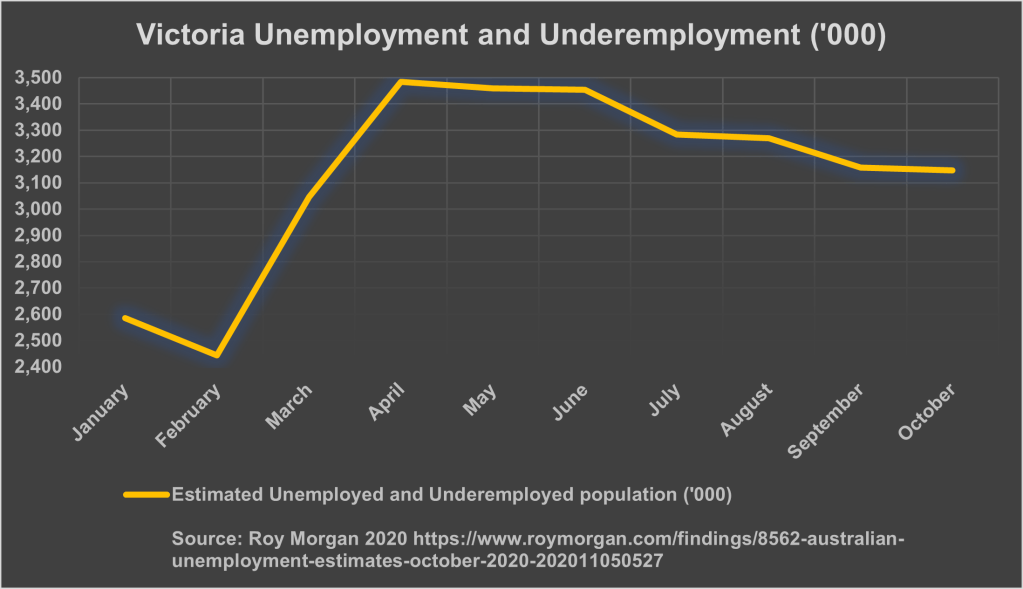
The average wait (of those with a reported waiting time) as of 30 June 2020 was more than 20 months. However VOHA has significant concerns about the backlog of care caused by the pandemic and it can be assumed that there are now many more people on the waiting lists, as well as more (recently unemployed) Victorians eligible for care. The below graph shows the estimated underemployed and unemployed population of Victoria, those of which are likely to be eligible for public dental services.

Waiting times for dentures are generally longer and are dependent on general dental care needs being met, meaning patients can often wait three years for general dental care and an additional 12 to 48 months for dentures.
VOHA believes these times are evidence of a significant inequality in Victorian health care and urges the Victorian Government to address them as a matter of priority.

You can check the waiting list times of your nearest clinic as of 30 June 2020 HERE.

Good Oral Health Beyond Reach For Many Australians 

Oral health is fundamental to general health and wellbeing. But there continues to be a divide between the ‘have’ and ‘have nots’, which has certainly worsened during the COVID-19 pandemic.

With public dental waiting lists in some areas from three to four years, and delayed dental treatment due to dental practice restrictions throughout the second duration of lockdown in Victoria, the price we all pay will be heavily felt by those unable to afford private dental care, or timely public dental care.

The following stories are some reflections on the state of public dental care by clients, advocacy groups and service providers.

“A client said there were long waiting lists with public dentistry (up to 12 months) but he couldn’t wait so just went to a private dentist and paid full price, which was why he needed help with food from us.”

 “Private dentists? Way too expensive. Public dentists? Can’t get in – have to wait 3 years in my area.”

“I’ve had to pay for these services, so there has been a financial impact.  I would go more often if services were free.  I am putting off seeing a dentist at them moment because the pain is tolerable.”

“As a child, a young man lived with his Grandmother in a remote area until age 8 and during this period he caught chicken pox which was left untreated.  As a result, Ari became very sick and needed strong antibiotics over an extended period.  This caused permanent damage to his teeth and by the time he was an adult his teeth were severely discoloured, brittle and breaking.  The normal waiting time to be seen at the local dental clinic is 4 years.”

“A 40-year-old female has had a long, painful history of dental treatments. First at the age of 9 when she broke her front tooth. She has had several procedures to fix this including drilling into her good teeth and a bridge put in. The client has been in pain for 6 years due to decaying teeth and teeth close to the gum line.”

These stories reiterate the importance of a long term sustainable funding model for oral health care. 

How has the pandemic impacted community dental care services?

COVID-19 IMPACT

We asked a few providers this month what impact COVID-19 has had on patients and services provided.

What have dental services seen as their biggest challenges during this time?

  • Doing treatment without producing aerosols – an area of high concern for practitioners and consumers, so we had to halt most treatment.
  • Trying to provide advice via telehealth to help consumers make sure their disease/symptoms didn’t get worse.
  • Inability to complete consumers’ treatment within normal periods of time – we have 1200 people in mid-care now
  • However reported rates of infection by oral health staff have been very low – perhaps less than 1% of staff have been diagnosed – so infection control has been effective
  • Big increases in waiting lists

What have they seen as their biggest successes?

  • COVID-19 has been an opportunity for change, so have changed our systems
  • We have had to focus more on prevention – we have talked more to consumers via telehealth
  • Consumers have a heightened appreciation of the need for regular care “I’ve been waiting for this appointment so long”

What key insights/lessons have been learnt?

  • We have done (and should continue to do) more preventive work
  • But funding is based on treatment, this needs to change
  • Telehealth can assist in triaging patients early and better (which patients appreciate) and do preventive work better (95% of our education was by telehealth during the pandemic)

VOHA Submission – Inquiry into Regional Inequality in Australia

VOHA recently made a submission to the Senate Standing Committee on Economics for its Inquiry into Regional Inequality in Australia. The Terms of Reference for this Inquiry can be found HERE.

VOHA’s submission addresses the following Terms of Reference:

a. improved co-ordination of federal, state and local government policies,
b. enhancing local workforce skills and;
c. any other related matters. – specifically health.

VOHA highlights the following points in its submission:

  1. Oral health care is not discretionary care
  2. Oral health care is primarily an individual expense with limited Commonwealth and state and territory funding available
  3. VOHA’s primary concern is that there is an unacceptably long waiting period to access public dental care in most of regional Victoria
  4. Waiting times for dentures are generally longer and are dependent on general dental care needs being met
  5. The eligible population (for public dental services) is not small
  6. VOHA has considerable concerns about the short and long-term impacts of the delays in oral health care caused by the COVID-19 pandemic and;
  7. There is a significant spatial maldistribution of dental practitioners.

You can view a copy of VOHA’s submission HERE.

VOHA Submission – Inquiry into Regional Australia

VOHA recently made a submission to the Select Committee on Regional Australia for the Inquiry into Regional Australia. The Select Committee was appointed to inquire into and report on the following Terms of Reference:

  1. Examining the effectiveness of existing regional service delivery and development programs;
  2. Examining the contribution and role of regional Australia to our national identity, economy and environment;
  3. Promoting the development of regional centres, cities, towns and districts including promoting master planning of regional communities;
  4. Promoting private investment in regional centres and regional infrastructure;
  5. Examine the key drivers for unlocking decentralisation opportunities for both the private and public sectors;
  6. Promoting the competitive advantages of regional location for businesses;
  7. Investigate the development of capital city size regional centres in strategic locations and the benefits this offers regional cities, capital cities, the Australian economy and lifestyle;
  8. Examine the potential for new developments, towns and cities to be built in regional Australia;
  9. Examining international examples of nations who have vast and productive regional areas, which are sparsely populated;
  10. Examining ways urbanisation can be re-directed to achieve more balanced regional development;
  11. Identifying the infrastructure requirements for reliable and affordable health, education, transport, telecommunications, clean energy, water and waste in a new settlement of reasonable size, located away from existing infrastructure; and
  12. Consider other measures to support the ongoing growth and sustainability of regional Australia.

A copy of VOHA’s submission can be found HERE.

Dental Health Week Webinar 7 August 2020

Where to from here? The impact of COVID-19 on oral health in Victoria’ was a webinar hosted by VOHA on 7 Aug 2019.

The Victorian Oral Health Alliance hosted a webinar during Dental Health Week, highlighting some of the key issues COVID-19 has and will have on Victorians oral health. Chaired by Mr Tony McBride, the panel was consisted of:

  1. Dr Dushy Umakhanthan, Senior Dentist from Starhealth
  2. Associate Professor Mathew Hopcraft, CEO of the Australian Dental Association Victorian Branch
  3. Ms Emma King, CEO of the Victorian Council of Social Services
  4. Professor Julie Satur, Head of Oral Health Therapy from the University of Melbourne
  5. Mr Danny Vadasz, CEO of Health Issue Centre

Highlights from the webinar noted the following key issues:

  • Dentistry is seen to be a high-risk for COVID-19 transmission
  • Dental restrictions to dental practice to many only urgent care have meant people are delaying necessary dental care
  • Further delays in dental care will result in increasing long waiting lists in the Victorian public sector before COVID-19
  • For example, Starhealth have seen increased adult general waiting lists by 125% and denture waiting periods by at least 500%
  • Increasing unemployment due to COVID-19 will result in more eligible Victorians being able to access public dental care
  • Many more Victorian cannot afford to seek timely preventive dental care
  • In general, Medicare does not fund oral health
  • Poor oral health are risk factors for poor general health
  • Dental and oral health students can no longer see patients due to dental restrictions
  • Lost opportunities to develop interprofessional practice and experience outreach program to reach vulnerable populations
  • Despite cessation of dental practice by students, their competence would need to be the same for graduation
  • Noted the concerns of a large proportion of COVID-19 transmission is among healthcare workers
  • Lack of consumer engagement and consultation throughout COVID-19 has created missed opportunities for a strong community response to the pandemic

Despite pressures of COVID-19 to provide necessary dental care, there is potential to shift how dental care is provided, including:

Stronger focus on prevention and minimally invasive dentistry

Use of telehealth to offer dental services

  • Strengthen infection control measures beyond COVID-19
  • Trial and receive feedback from consumers regarding different ways to deliver dental care such as remote dental emergency triaging and offering preventive oral health advice
  • Local communities and organisations have responded to meeting the needs of vulnerable communities affected by COVID-19 such as residents living in high-rise housing estates.
  • Stop relying on data to offer practical solutions
  • Leverage consumer voices and generate stories to influence governments and politicians

Public Dental Waiting Times

Public dental waiting time data.

Long waiting times for dental care mean existing dental problems worsen. As a result, just over one-third of all courses of care are for emergency treatment rather than routine care. 

People with poor oral health may experience pain and embarrassment, have trouble speaking and eating, miss school, have trouble getting a job, and develop other serious health problems. That’s why it’s so important that all Victorians have access to regular dental care.

VOHA is calling on both the state and federal governments to increase their investment in public dentistry so that vulnerable Victorians are able to smile.

More data will be available soon.