
The bottom line is that funding for public oral health care and broad preventive measures continues to remain, at best, stagnant in real terms. While total funding is increased by 2.3%, the decline in funding per eligible Victorian continues downwards – a 32% reduction in real terms since 2019-20. Again, the overall level of funding is only enough to treat every eligible adult on average once every seven and a half years, clinically a desperately inadequate level. Lastly, there appears to be no uplift in preventive measures, especially addressing the lack of access to water fluoridation in many towns in rural Victoria.
The most disadvantaged will continue to have the lowest access to oral health care, and the hospitalisation rates of children for potentially preventable conditions will undoubtedly continue to be unacceptably high, and on a rising trend.
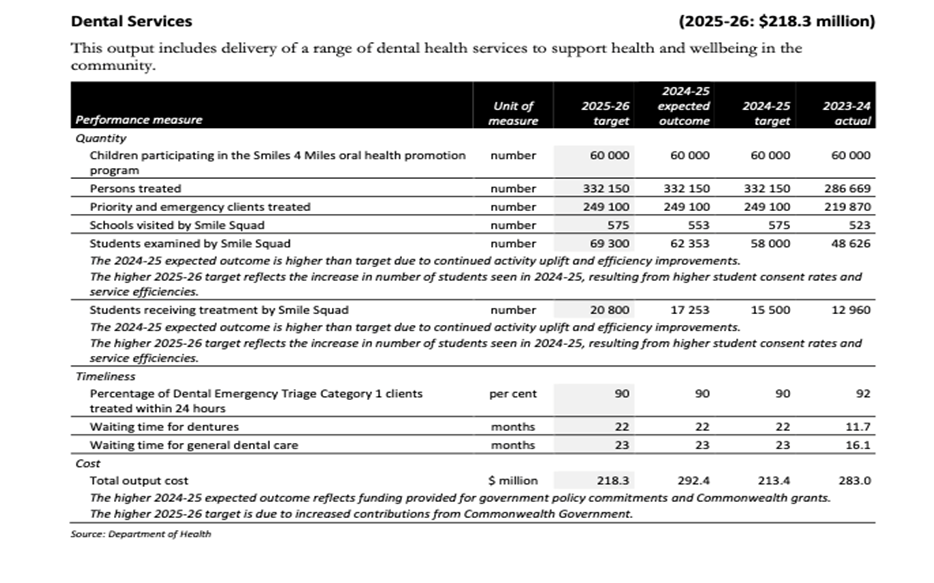
- The 2025-26 Budget papers allocate $218.3m of State funding to dental funding next year, an increase of 2.3%, although this is less than actual costs of care.
- In addition, there is an estimated annual Federal allocation of about $27m – a figure unchanged for many years. This gives a total of about $245m.
- Crucially, while this is only a very slight decrease in real terms from last year, this level of funding continues to represent a huge decrease from the pre-covid era, a 35% reduction per client in CPI adjusted terms, but with little change in expected targets of number of people seen – 332,000 people (Royal Dental Hospital Melbourne + other community agencies) out of 2.45 million Victorians eligible for public sector care.
- There is an as yet unexplained $50m reported as being spent in this current financial year but it does not continue into 2025-26.
- Waiting time benchmarks remains stuck at 22 or 23 months, although the published actual averages for general clients are much lower. At June 2025 the available data shows over half (52.73%) of all clients on the general list (non-urgent or priority) waited longer than 12 months (although VOHA believes this is an under-estimate of people’s actual wait times). However, there is wide variation in the averages – Victorians in some areas have to wait much, much longer, e.g. 36.4 months at Sunraysia Community Health Services, 25.8 months at Latrobe Community Health Service, 25 months in West Wimmera Health Service, and about 50% of the eligible population come under the priority access policy and are able to access services without waiting.
- The current highly constrained funding regime has negative implications. While the system rightly provides timely care for priority groups, urgent care (which often reflects lack of earlier preventive care) takes up high levels of treatment time. Thus, on average services are only left with about 65% of their capacity to address the long waiting lists for general care.
- Smile Squad, which is predominantly funded by the Commonwealth’s Child Dental Benefits Scheme, is expected to visit 575 schools this year (up from 553 this year) and see and treat more children – 69,300, an 11% increase. Low-fee independent schools are meant to become eligible this year but exactly when is not known. As commenced last year, all secondary schools will only be visited every two years, not annually. VOHA remains concerned that the Smile Squad services are unable to be accessed by those who would most benefit from the service (the program is affected by ‘The Inverse Care Law’).
FUNDING PER PERSON COMPARISON 2025-26 with 2019/20
| Year | Budget allocation | Allocation adjusted to 2025 dollars* | Target persons | Funding per client in 2025 $ | % change from 2019-20 |
| 2019-20 | $294m | $354m | 324k | $1,093 | |
| 2025-26 with Commonwealth NPA$ | $245m | $245m | 332k | $738 | -32% |
*Adjusted by RBA CPI rates ** Assumes $27m Commonwealth FFA
Targets and funding from Budget Paper #3
FYI the only Departmental Objectives relating to oral health is around ‘children aged 0-9 years old who have been hospitalised for dental conditions’ (i.e. to reduce this rate). The Budget makes no further mention of this, presumably as it is an operational matter.
Unclear areas of Budget and funding
It is not at all transparent how the reported expenditure in the Budget papers matches up with the Funding Agreement that the Department of Health has with DHSV.
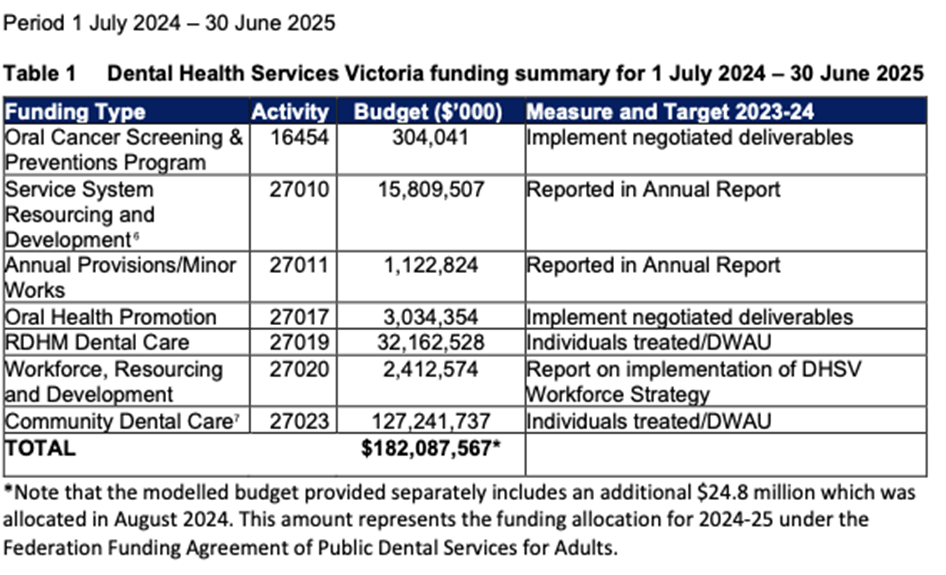
As noted above there was $238m effectively allocated in the combined State/Federal Budgets this year to dental care. However, according to DHSV’s 2024-25 Statement of Priorities (below) signed by DHSV and the Minister[1], DHSV will only receive $182m this current financial year (see below). Adding in last year’s $25m Commonwealth money and a similar amount for 2024-25 would bring the total to $232m.
This is a far cry from the $292m expected expenditure described in the Budget for this year. It is not at all clear to VOHA yet where this extra $54m was spent. Whatever it was, it has not flowed into the coming year. We will explore further but it remains true that there is considerable lack of transparency about dental funding in Victoria.
[1]. https://www.health.vic.gov.au/sites/default/files/2025-03/dental-health-services-victoria-statement-priorities-24-25.pdf

